|
|
 |
Reply
| |
Pagan: A pagan is someone who adheres to a belief system outside of that which is considered orthodox. Orthodox belief systems are that of Judaism, Islam, or Christianity. The beliefs shared by Pagans are wide spread and difficult to categorise they often relate to nature and mother earth. The religion of Wicca falls under the category of a pagan religion. |
|
Reply
| |
Paradox: A situation where two facts/situations are opposite or contradictory, yet both appear to be (and sometimes are) true. A 'paradoxical tension' is when the two contradictory truths hold each other accountable; in a sense, each keeps the other true. |
|
Reply
| |
Paranormal: para - (beyond) + normal (that which is normative or that which follows the general rule). That which doesn't happen within the normal limits of material living or which can't be explained by the laws of nature or physics. A catch-all category of popular thought, designed to mix together all that is weird, whether fairly or unfairly, related or unrelated. |
|
Reply
| |
Past Life Regression: A technique used by hypnotists to lead a person in a trance which allows them to supposedly recall events from previous lives, when their soul was in a different physical body at another time period and place. |
|
Reply
| |
Pendulum: A tool often used to communicate with spirits or divine. |
|
Reply
| |
Pentagram: A five-pointed star drawn with a single line.
Upright, it resembles a human figure, with spirit taking the highest importance. Inverted (upside-down) it is often considered a Satanic symbol. This is not always true, though. In Wicca an inverted pentagram is a sign used by a second degree initiate to symbolise their progress and the facing of the "dark" side of life. When inverted, it represents the elements taking precedence over spirit. The Pentagram. The Pentagram is a five pointed star. | The pentagram or five pointed star is an ancient Pagan symbol.
(As is the pentacle--which is a pentagram inscribed in a circle.)
Its history is probably one of the oldest in the Craft, as historians suspect that the Sumerians used the Pentagram in their rituals, and held it as a sacred object. It is for this reason that the pentagram has survived into Wicca as an object to encompass our belief system. The pentagram however is not simply a pretty symbol. It has very deep meanings, though it means different things to different witches.
I wear a pentacle daily, and when people ask me what it means, I often have a hard time choosing the definition. The pentagram is a very powerful symbol, and understanding it can offer the student great insight into her religion.
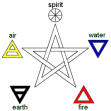
The top point of the pentagram represent the element of Spirit--it represent the ethereal, the everlasting, and the immanence of the Goddess. It represents our souls; it represents the parts of us that are dedicated to Witchcraft, and dedicated to a spiritual connection to the Earth and to each other. It symbolizes spiritual love.
All of the remaining points of the pentagram relate to the human experience--our lives as being purely profane creatures, made of body and material. The entire pentagram has been said to represent the human--the top point the head and the bottom four the body. In a sense, this is true. The bottom four points will be described below.
The top left point of the pentagram represents Earth.
Earth is the Mother element. It is that element that represent rootedness. It symbolizes security, growth, nourishment--all of the things that the Earth Mother provides for us. The elements Earth is what offers us the ability to explore the spirit, because it gives us grounding. Without Earth we would always have our head in the clouds. Earth is represented by Coins/Pentacles in the tarot deck.
The top right point of the pentagram represents Air.
Air is the element of the mind. It represents thought, intelligence, rationale. It is the element that allows us to examine the spirit and discover where it fits in our lives. Without air, the element of Earth would have little use, for though we are grounded in Earth, we are allowed to reason out our spirits with Air. Air is represented by Wands/Staves in the Tarot deck.
The bottom left point in the pentagram represents Fire.
Fire is the element of the loins. Fire represents passion. It represents that part of us that wants to overthrow reason, to lead by the horns, to plunge on without thinking about our actions. Fire is symbolic of adrenaline, of testosterone, of brashness. Once we have progress past air and have analyzed our spirits and our paths in life, fire allows us determine whether that analysis is right for our lives. Fire is what allows us to say, "I Don't care if it makes sense, this is what I believe." Without fire, we could not perform Magick, we could not link ourselves to each other. Fire overrides the intellect. Fire is represented by Swords in the tarot deck.
The last point, the bottom right, is the element Water.
Water represents the cycle of life: we came from the watery dark of the womb, and we return to watery tears of death. Water is the element of emotion. Water is the element that validates our existence as sentient beings, because it allows us to have feelings, but not the brash, unwarranted feelings of fire. Water is the emotion that comes along with understanding ourselves and each other after all else has been discovered. Water is pure love, pure joy, pure sadness, pure anger. Water is not childish--it knows why we feel the way we do. Water is the element that calms fire--it emotion with reason. Water is represented by Cups in the tarot deck.
When the pentagram is inscribed in a circle--a pentacle--it unites all of the aspects of man. It unites the body with the mind, the spiritual with the profane. It reminds us that we need all of our aspects to fulfill our lives as human beings. It reminds us also everything is a cycle--that we will not experience joy without pain, but pain will again give way to joy. When the pentacle is worn right side up, it represent "spirit over the body". This means that as witches, we recognize the importance of all things, but when we get right down to it, we strive to serve the spirit and not solely our bodies. "An it harm none" means that serving the spirit may mean sacrificing bodily pleasures, but if we are serving the spirit, we can never harm.
When the pentacle is worn upside down in Satanism, it means "flesh over the spirit", meaning, if it feels good, do it, regardless of who you hurt.
This symbol NEVER HAS THIS MEANING IN WITCHCRAFT!! If a witch wears the pentacle inverted, it means that she is undergoing a period of introspection and self discovery, and that she is going through the underworld to confront her fears and demons and conquer them.
| |
|
Reply
| |
Polytheism: A belief in a plurality of gods, not necessarily equal in importance, each of which is distinguished by a special function. The Indian Vedas, for example, feature Agni the fire god, Vayu the wind god, and Indra the storm god. |
|
Reply
| |
Prana: The yogic concept of a cosmic energy or life force, similar to the Chinese idea of chi, that enters the body with the breath. Prana is thought to flow through the body, bringing health and vitality. It is considered the vital link between the spiritual self and the material self. |
|
Reply
| |
Precognition: (Seeing the future) is commonly experienced by clairvoyants and empaths. This is generally a random power, in that a premonition can happen suddenly and even in dreams. In dreams, the outcome is similar to that of a vision and can not always be distinguished as such. |
|
Reply
| |
Prophet: Someone who receives inspiration, information, or insights into the future from a divine source. |
|
Reply
| |
Psychic: As a noun : a medium or channeler, one through whom the departed or the other inhabitants of the spirit world speak through.
It can also refer to paranormal matters of the mind which are described as 'psychic' phenomena |
|
Reply
| |
Psychic Abilities: Perceiving, receiving, or transfering information without the use of the 5 common senses (sight, touch, hearing, taste, smell). |
|
Reply
| |
Psychokinesis: Mind over matter. The alteration of the state of an object by mental influence alone. This is similar to telekinesis but is less direct. It is the chanelling of energy to 'make things happen' or as the dictionary says - 'set objects in motion'. This usually happens with visualisation in an altered state like meditation.
An example of this would be that you want to knock an object over, nothing happens untill several minutes later your dog does it for you. |
|
Reply
| |
Psychology: As a science, psychology is the study of human and animal behavior and mental processes. Philosophically, psychology is the division of metaphysics that explores the soul and the mind. According to the American Psychological Association, at the present time there are fifty two sub-fields under the umbrella of psychology. History - Two major figures contributing to the development of psychology were none other than Sigmund Freud and Carl Jung. - Freud pioneered psychoanalysis and psychotherapy at the turn of the 20th century. By observing his patients, he developed his controversial theory of childhood sexuality. Freud was responsible for developing the practice of free association and terms such as defense mechanisms, libido, id, ego, superego are attributed to him. He also recognized the importance of dreams.
- Jung was a great mind and mystic. He was once a close colleague of Freud's until a falling out do to a difference in opinion. Jung believed that along with Freud's "personal unconscious", there existed the "collective unconscious" that was shared by all humans. Rather than the complexes of the personal, the collective is characterized by "archetypes" or "instinctual patterns of behavior and perception" which can be traced in dream and myths. Together, all the archetypes of a person is called the "self". Rather than the sexual theories presented by Freud, Jung believed that the unconscious was driven to wholeness, balance and the attainment of the self through what he called the "process of individuation" - a sort of metamorphosis of the soul. He developed the theory of the ego comprised of the persona and the shadow.
|
|
Reply
| |
Psychometry: This is the power to know the condition and/or background of an object, place, or person. This is often done through touch.
Different methods of this are -
Aura Sight: seeing the energy around the object/person.
Empathy: the emotional impression of another (The empath does not share the sensation, but literally feels it) |
|
Reply
| |
Purna: Purna is a Hindu term which means perfect. It means perfection in relation to mastering the negative aspects of your ego. It can also mean completeness or wholeness and is usually used in the context of the whole of creation. |
|
|
|



 Free Forum Hosting

 Important Announcement


 First
First
 Return to Dictionary