Front sight
The conventional sight picture with conventional handgun sights is the one you see in the marksmanship manuals. The front sight is centered in the notch of the rear sight. The top of the front sight is level with the top of the rear sight, and there is an equal amount of light on either side.
Human vision being what it is, you can’t focus on the sights and the target at the same time. Actually, you can’t focus on both the front and the rear sight at the same time, either. Once the target has been identified as something you need to shoot, you no longer need your primary visual focus on it. Primary focus now goes to the aiming indicator, the front sight. Think of it as a fighter pilot would: “enemy craft sighted, lock missiles on target.�?The way we lock the handgun’s missiles onto the target is by focusing on its front sight.
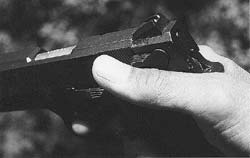
With a slide mounted safety as on S&W Model 457 compact .45, shown, author prefers this grasp, with thumb at upward angle to guarantee release of safety catch. | |
Failing to properly focus on the front sight is a widespread problem among shooters. Every good shooter with iron sights (as opposed to red-dot optics or telescopic sights) whom you know can probably remember when he or she experienced “the epiphany of the front sight.�?The realization, “So that’s what the coach meant when she said to watch the front sight!�?
Watch the front sight hard. Apply your primary visual focus there. Look at it until you can see every little scratch in the machining on its surface. If it has a dot on it, focus on it until the dot looks like a soccer ball. Then you, too, will experience the epiphany of the front sight, and will see your shot groups tighten as if by magic.
Smoothly roll the trigger
Remember the prime directive: once the gun is aimed at the target, the trigger must be pulled in a way that does not pull the muzzle off target before the shot is fired. This means that the trigger must come straight back.
You want a smooth, even, uninterrupted pull. You can say to yourself, “press the trigger.�?You can say to yourself, “sque-e-eze the trigger.�?I say to myself, “roll the trigger,�?because that connotes the smooth, consistent, uniform pressure I’m trying to apply. You don’t want the shot to truly surprise you, of course, because that would be an unintentional discharge. Rather, you want the exact instant of the shot to surprise you, so you don’t anticipate it and convulsively jerk the shot off target.
Experts agree that the best way to get the trigger pull down, once you know what it’s supposed to be, is to practice it. Dry-fire, or “clicking�?the empty gun, is the best practice. The position of the sights when the gun goes “click�?will tell you whether the shot would have been on target or not. The more thousands of these repetitions you perform, the more the proper trigger pull will be hard-wired into your mind and body to the point where you can do it perfectly in an emergency without consciously thinking about the details.
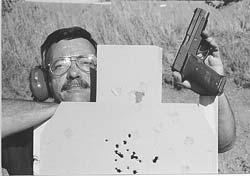
Accuracy tends to degrade with speed. Author fired the chest shots in hyperspeed mode, the eight shots in one hole in the neck at a more deliberate pace. Pistol is SIG P220 .45. | |
The best way to learn it is with what I dubbed the “exemplar drill.�?Find an accomplished pistol shooter to assist you. Take a strong stance and firm grasp, and hold the gun on target. Let your index finger barely touch the trigger, and let that finger go limp. Ask the seasoned shooter to place his gun hand over yours, and his trigger finger over yours, and let his finger press yours straight back against the trigger. After several repetitions, you’ll be feeling what he feels when he makes the perfect shot. This is the easiest way to learn what a good trigger pull feels like.
Now progress to the two of you pulling the trigger together at the same pace. After some of that, you’re ready for the third stage. Now it’s your finger pulling the trigger, his lightly touching yours to monitor its progress. Once you’ve got that down, let the coach sit back and watch as you “fly solo,�?making corrections as necessary.
Some suggestions
Observe all rules of safe shooting and safe gun handling, of course. Start with paper or cardboard targets in close, at three to seven yards. If your shot is off the mark by three inches at 25 yards, it might have been just the natural limits of the gun’s accuracy. It might have been the ammo. It might even have been the wind. But if you’re off by three inches at four yards, you’ll know exactly what it is. The closer you are, the easier it is to correct whatever caused the bad hit on the target. Once you’re hitting in tight groups at close range, move back incrementally. As the distance increases, so does the challenge.
A special thank you to: Massad Ayoob & American Handgunner Magazine "Printed with the permission of American Handgunner Magazine
(www.americanhandgunner.com)"
POINT SHOOTING:
The late Col. Rex Applegate was well respected for his ideas, training methods, and training results with point shooting.